AND SOCIETY'
BOOK 3 - ALL DIMENSIONS
human society. Our attitudes seem to drive more than just our moods. They also seem to drive our
philosophy, our politics, our attitudes to religion and most other social thoughts. Behind it all lies the
workings of the human brain.
 | |  | |  | |  | |  |
still in preparation. However, in this book the same lowest
common denominator psychometric method is used to
consider attitudes to more complex social topics such as
philosophy, religion, education, politics and war. These
subjects are viewed mainly from the point of view that it is
possible to classify and even quantify the relative degrees
of 'insane' attitudes that create the various ideas that drive
such human endeavour. The way in which ignorance is
highly associated with the tendency to suffer from extreme
views is to be fully discussed. Similarly, the vulnerability of
such people to indoctrination and propaganda is
considered within the context of mood changes which are
seen to often occur within 'masses' of people.
It becomes clear therefore that the most interesting people
are often those with extreme views or belief systems.
Indeed, many of the most significant events of history seem
to have been driven by people with such extreme views.
Their personal philosophies seem to have been the product
of the extreme emotional forces that determined their
underlying personalities. Such people then tend to
surround themselves with 'acolytes' who adopt and
propagate their belief systems. Positive attitudes such as
generosity, tolerance and forgiveness have indeed
changed history from time to time. However, negative
attitudes including hatred, revenge, jealousy, zealotry,
bigotry and intolerance seem all too common even in
today's fairly sophisticated world.
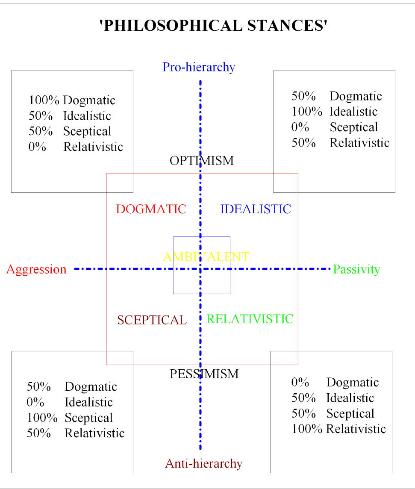
PHILOSOPHICAL 'STANCES'
Fundamental therefore to the 'Psychometric' hypothesis in
developing a new epistemiology of Philosophy, is the idea
that one's 'base' psychological attitudes can drive one's
higher thoughts. Also one can adopt ideas from other
people's philosophy, thereby sublimating one's own
emotions. This can often therefore result in quite bizarre
juxtapositions of attitudes which may not always obviously
follow the way in which 'base attitudes can be observed.
However, the basic patterns seem quite clear. The four main
'Stances' seem to be related to the 'corners' of the grid. For
example, 'Dogmatic' is equivalent to the 'top left' of the grid.
This stance can however be broken down into it's
composite parts as shown in terms of the percentiles of
each stance a person is likely to exhibit. A person
'inhabiting' this area will be highly dogmatic, but will tend to
be only partially 'idealistic' and 'sceptical'. They are however
highly unlikely to be 'relativistic' or passive in any way.
These various 'stances', generated primarily by variations in
levels of aggression and self-esteem, seem then to relate to
levels of other 'secondary' attitudes such as optimism and
pessimism. They also seem to alter a person's more specific
social attitudes such as the way in which a person will
become 'pro' or anti-hierarchical.
PHILOSOPHICAL 'TYPES'
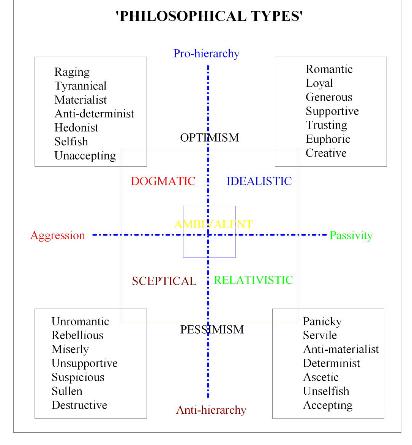
In such a way then are the various 'Types' created. Their
main attitudes and attributes are as shown. Their
importance is the way in which extreme and even perverse
philosophies are created. This can result in quite extreme
behaviours where great harm can come to others or where
extreme passivity results in harm to themselves. Often,
such extreme belief systems may come in to conflict with an
individual's 'base' attitudes and result in marked inner
conflict.
REASON, REALITY, REPRESSION AND DENIAL
Thoughts and ideas beyond 'reason' and 'reality' can be
readily classified using the grid and cube. A series of points
on the various 3-D crossed dimensions can be used to
denote the types of thought as well as their intensity.
Repression is a fascinating phenomenon where an
individual 'sub-consciously' is able to block out certain
thoughts. These thoughts are often painful and there is no
doubt that the brain has mechanisms to this effect. Such
repression seems to occur even in the presence of severe
ignorance. However, 'Denial' by definition, seems to relate
to a more conscious mechanism, where perverse insight
can modify thoughts and cause an individual to ignore
certain aspects of reality. Such people look as it were
through a distorted lens where certain ideas are
'unthinkable'. It would seem therefore likely to be the case
that sub-conscious 'repression' and ignorance can exist
together in the same individual alongside more conscious
'denial' and perverse insight, albeit in different proportions
in different people.
SELF-CONTROL AND CONTROL OVER OTHERS
We tend to accumulate 'wisdom' over time by having a
variety of experiences. This wisdom or 'insight' is however
not only dependent upon those experiences, but also our
ability to learn from them. Sometimes however we do not
learn or may learn in a biased way. We often turn to others
for help in explaining events and thereby open ourselves to
indoctrination by extreme beliefs and perverse
philosophies. Indeed, whole civilisations can be built upon
indoctrination of the masses with social control becoming a
function of bizarre promised rewards or punishments.
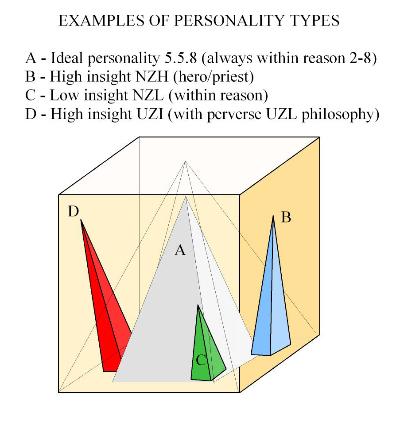
True 'freedom of thought' and therefore self-control seems
to rely upon the ability to observe and understand all the
various ideologies that 'surround' as it were the sane and
'centred' individual (represented as type A on the adjacent
diagram). Other types of people will usually try to convince
others of the 'correctness of 'their' ideas, (e.g. types B, C
and D). Self-control can be based upon surrogate and
second-hand ideas, but perhaps is best based upon one's
own appreciation of all the various social and emotional
forces that exist. One is therefore perhaps best to at least
start from an unbiased, ambivalent position before adopting
the 'appropriate' philosophical position according to
circumstances.
As Aristotle said: - “Anyone can become angry – that is easy.
But to be angry with the right person, to the right degree, at
the right time, for the right purpose and in the right way – this
is not easy”
Indeed, one can always still remain agnostic in the face of
any uncertainty rather than responding to every situation
with a 'set' response. Indeed, 'open-mindedness' would
appear to be a function of not only high insight but also a
'centred' starting point in any debate. Conversely therefore,
closed-mindedness and prejudice seems to usually be the
result of possessing an extreme philosophy.
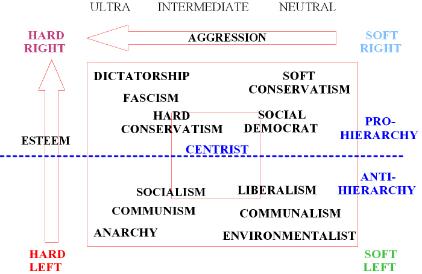
POLITICS AND RELIGION
The study and epistemiology of 'Politics', like all other social
science disciplines, seems capable of being enhanced by
consideration of 'applied psychometrics'. Political views
therefore can be seen as a form of higher social insight
which can be modulated by psychological forces within the
individual and by mood changes within social groups. The
diagram shows how the 'hard right' seems to equate with
the 'top left' of the grid and so on. Different political
ideologies can therefore be understood as a series of
'areas' on the 'grid' which have extreme political views at
the edges and moderate views in the centre. Attitudes to
hierarchies are fundamental to the system and levels of
aggression drive the vehemence and energy with which any
policies are pursued.
Religion and morality also lies at the heart of how a society
controls it's members. As Socrates famously said: -
"ignorance is at the root of all sin". The 'grid and cube' seem
eminently suited to the classification of the 2000 or so sins
known to man as they are usually seen to be highly similar to
those extreme attitudes located around the periphery of the
grid. We all know about the Seven deadly Sins, but it would
appear to be the case that all of us have a different view
when it comes to the relative importance of each sin! Our
opinions in this regard seem therefore to be very much
determined by our own individual philosophical position.
Indeed, the 'Insight-ignorance' dimension seems to be a
highly useful concept when considering the differences
between conscious and voluntary acts of good or evil and
behaviour which is the result of simple ignorance. Willful
ignorance therefore can be seen as a form of 'sin' where
devious economy with the truth is just one of many
strategems employed by higher insight individuals.
Increased levels of 'religiosity' within a society seems to
result in the recruitment of more aggressive and intolerant
sections of a population (Ultra Zones) into religious activity.
This tends to cause intolerance and the forced imposition of
ideas by those aggressive types. This is just one of many
examples of how analysis of attitudinal change within
proportions of a population using the grid can be a useful
way of considering why social events occur as they do.
Similarly, control over the populace seems also to be
effected by causing changes in the mood and attitudes of
the masses. This book provides many examples in history
which demonstrate this logic.
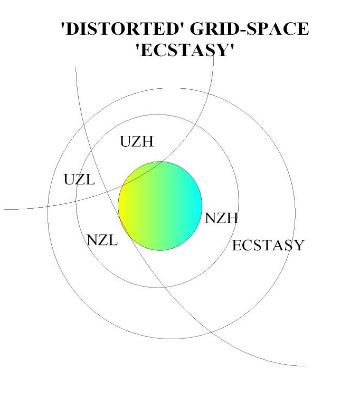
DISTORTION OF THE 'CUBIC SPACE'
The workings of the human brain are becoming less
mysterious by the decade. Neurophysiological and
pharmacological evidence including brain scanning is
increasingly providing new insights into why we behave th e
way we do. Various 'centres' and 'pathways' are now seen to
specifically deal with thoughts such as 'reward' and
'pleasure'. The space within the 'cube' therefore can be
seen as being liable to distortion caused by various stimuli
including drugs, hormones and even behaviour such as
starvation and overbreathing. Falling in love for example is
being increasingly seen to be an 'involuntary' physiological
event as much as it is a conscious phenomenon. The book
describes the latest ideas on such subject but presents
them within the context of distorted thresholds within the
brain and over-stimulation and under-stimulation of
different brain 'modules'. Ecstacy for example can be
considered as an expansion of a particular space within the
cube which results in a significant rise in the incidence of
certain euphoric ideas experienced by the affected
individual.
CONCLUSIONS
The essence of this book however is most certainly still the
desire to understand and classify the wide variety of
attitude sets and philosophies that so obviously exist.
'Sanity' as we have seen, is defined as the avoidance of
extreme views. The great driving force for humanity is our
ever-present need to understand. However, so often this
curiosity seems to result in an overwhelmingly strong 'allure
of certainty' . So often therefore this 'allure' drives us in
search of the various types of 'truth' that lie around the
edges of the grid. The grid can therefore hopefully assist
us to understand not only why certain distorted 'truths'
exist, but also why certain individuals are attracted to them
at various times in their lives.
Perhaps therefore 'Truth' can only be achieved where it is
certain that our attitudes are indeed centred and balanced.
Ambivalence and agnosticism seem to be the logical
starting points for all debates. However, so often does it
seem to be the case in history that those who have sought
to express balanced views have themselves become the
victims of the low insight and insane members of their own
societies. To achieve higher levels of insight can therefore
attitudes and extreme emotions. High insight
agnosticism is therefore not to be confused with lower
insight apathy. Ambivalance therefore can either be
high or low insight in nature, but with the difference
being that the higher insight agnostic knows why he is
adopting that position and is therefore much less likely
to change and follow the crowd. As Socrates painfully
found out, there can be severe consequences for
someone who adheres to his principles.
TRUE PHILOSOPHERS?
The definition of a 'True philosopher' seems therefore
to be related to the ability to be able to as it were
understand and classify all the other 'philosophical
positions'. Where bias towards one area of the grid
occurs and when prejudice exists then such people
are perhaps not even worthy of the term. Only a
select few have achieved such understanding while
maintaining highly centred and reasonable views.
Examples of such 'super-philosophers' include of
course Aristotle and his 'doctrine of the means' and
others such as Bertrand Russell whose mathematical
mind no doubt helped him 'plot' as it were the
attitudinal status of others.
However, both such philosophical 'giants' did not have
the benefit of the information revolution and the
massive expansion of physiological and psychological
knowledge that has occurred in the last few decades.
In so many ways therefore, the successors of these
men must embrace all such new technologies that
exist today before they themselves can define what
constitutes a logical epistemiology of philosophical
opinion. This book therefore attempts to use such a
polymathic approach, including use of mathematical
forms, to begin to 'position' one philosophy in relation
to another.
SPECIFIC EXAMPLES?
It is however the author's intention not to list any
specific previous examples in history of 'individual' or
'mass' insanity which would be likely to cause offence
or violent reactions by others. The intention therefore
is to simply rely upon 'generic' terms. In these
circumstances therefore it will be up to the reader to
make inferences based upon his or her knowledge of
history. The author apologises for this in advance.
The full manuscript of Book 3 may therefore not be
published for some time.