BOOK 1 - THE 1st AND 2nd DIMENSIONS
self-esteem (2nd Dimension) is the first step in understanding why people think and
behave as they do and why they treat others in such different ways."
a gross error. Use of the 'Moodgrid' shows that there are at least 'nine types of men' and
'nine types of woman' exhibiting very different levels of selflessness and supportive
behaviour. There are therefore at least 81 ever-changing permutations to consider during
the classification of partnerships."
 | |  | |  | |  | |  |
of the trilogy using the 'Moodgrid' . It tries to assist a lay
person to comprehend a series of issues about the use of
mood theory as applied specifically to Relationships. Very
little jargon is used and the information is presented in a
series of easy steps. It is hoped that by reading this book,
someone with no previous knowledge of 'Psychology' will
begin to appreciate how attitude analysis and applied mood
theory can revolutionise one's way of not only thinking about
oneself, but also types of other people, relationships and life
in general.
READING A MAP!
If you can read a map, then you can use the 'grid'! This book
uses the simple concept of the basic two-dimensional
psychometric 'grid' to discuss how levels of Aggression (X)
and Self-esteem (Y) can be related to types of Mood and
Personality.
A picture is worth 'a thousand words' and some colour
illustrations by Edmund Dulac of certain key interpersonal
interactions have been inserted to complement the text.
ATTITUDES AND ZONES
The way that one's 'attitudes' change according to one's
location on the grid is described in some detail. A decimal
system is used to enhance precision of thinking and specific
directions of change are also considered.
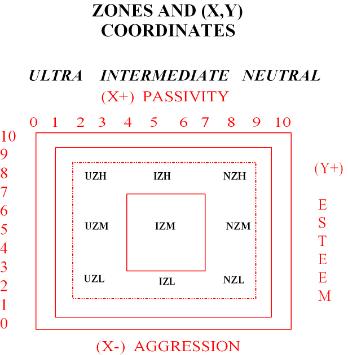
The grid is then divided into three main zones namely Ultra
(UZ), Intermediate (IZ) and Neutral (NZ). The adjacent
illustration however also shows the three sub-zones for each
of the main Zones where self-esteem is either high (H),
Medium (M) or Low (L).
Each of these sub-zones is examined in some detail,
including not only the attitudes and moods involved, but also
then what this means for a given person's dealings with
others in many spheres of life. The emphasis of this book
however is upon classifying inter-personal interactions and
relationships.
Following the theme of 'sanity' once again, around the edges
of the grid can be seen two further rectangles which
represent thoughts firstly 'beyond reason' and secondly
'beyond reality'. These concepts are introduced in PHH but
expanded upon in the other two books.
PERSONALITY TYPES
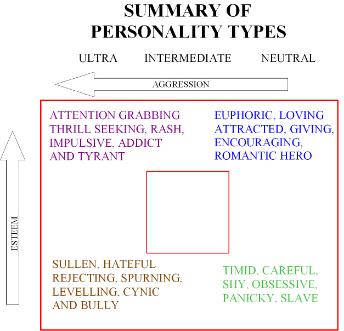
The main personality types are summarised here. The 'Nine
Moods of Man' have already been described on the Home
page but this diagram shows the main attributes for each of
the new corners of the Moodgrid. These include the 'Tyrant'
(UZH), The 'Hero' (NZH), The 'Slave' (NZL) and The 'Cynic'
(UZL). They each have their own set of attitudes as shown,
including not only their attitudes to relationships and
hierarchies, but also their personal philosophies and their
reactions to stress.
In addition there are those people who 'inhabit' the ''Box' in
the centre of the grid, who by definition are the most
'balanced' individuals of all. This box also represents the
Mood of 'Calm' and the attribute of 'Ambivalence'.
COMPATIBILITIES
Once self-esteem is taken into account there are then 9
types of men and 9 types of women to consider, rather than
the single male and female stereotypes so often described.
Discussions in the book lead to the conclusion that there are
therefore 81 ever-changing permutations and combinations
of interaction between the sexes to consider.
Compatibilities, stability of relationships and various other
partnership issues are therefore discussed in this context.
The quality of relationship for each type of pairing is then
discussed, including the effects of Mood swings and their
consequences.
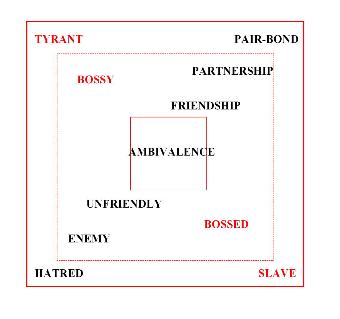
The effects upon relationships is summarised in the adjacent
diagram. Along the diagonal from top-right to bottom left on
the grid lies the Love - Hate axis. From top-left to bottom
right runs the 'Dominance - Submission axis. As such,
movements along these axes tend to have dramatic
consequences as shown for the relationships involved.
Jargon has been kept to a minimum in PHH, but considerable
detail with regard to such multi-dimensional attitudinal
analysis is included in the general discussion.
An alphabetical summary of 'grid-speak' is also included in
the book as well as some light-hearted personal assessment
questionnaires in the manner of popular magazines.
MEN AND WOMEN
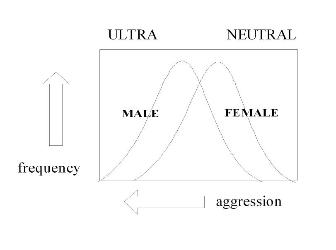
It is becoming increasingly realised that at least 10% of men
tend to think like women and vice versa. Issues of sexuality
make up a significant and highly important part of the book.
Once again, not much jargon is used, but perhaps enough to
improve understanding of the many differences and
similarities between men and women.
The grid, as described, was inspired firstly by ancient philosophy, which has
often sought to understand human nature by considering extreme and even
opposing attitudes. Aristotle, in his well-known book on 'Ethics', describes
one of the earliest recorded attempts at comparing and measuring human
attitudes. His method was to analyse attitudes by giving them 'high',
'medium' or 'low' values of a certain attribute. However, the proposed
assessments were only made on rather basic conceptual scales and
therefore could not easily be related to observed changes in Mood.
The 'moodgrid' has also been partly derived from the original circular 'mood
diagram' conceived by Hans Eysenck, a famous 20th Century London
Psychologist. His diagram, although widely reported and highly sensible in
terms of starting to think about psychometrics in two dimensions,
unfortunately never became popular. In retrospect, this may have been
partly due to a general misunderstanding of some of the terms he used at
the time.
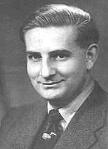
Eysenck
THE BOOK 'PHH' DOES STAND ON IT'S OWN WITH COLOUR PRINT ILLUSTRATIONS.
HOWEVER, IT IS STRONGLY RECOMMENDED THAT PERSONS CONSIDERING THE
PURCHASE OF THIS BOOK MOVE ON TO LOOK AT THE NEXT PAGE DESCRIBING THE BOOK
'ATTITUDES, MOODS AND INSIGHT'.
MOST OF THE RELEVANT PARTS OF 'PHH' ARE SUMMARISED IN THE FIRST PART OF 'AMI'
BEFORE MOVING ON TO DISCUSS THE 3RD (Insight) AND 4TH DIMENSIONS (Time).
'AMI' HOWEVER DOES NOT CONTAIN THE DULAC ILLUSTRATIONS AND CONTAINS MANY
MORE MATHEMATICAL FORMS
partners partners partners partners partners partners partners partners partners partners partners partners partners partners partners partners partners partners partners partners partners partners partners partners
partners partners partners partners partners partners partners partners partners partners partners partners partners partners partners partners partners partners partners partners partners partners partners partners
mood mood mood mood mood mood mood mood mood mood mood mood mood mood mood mood mood mood mood mood mood mood mood mood mood mood mood mood mood mood mood mood mood mood
mood mood mood mood mood mood mood mood mood mood mood mood mood mood mood mood mood mood mood mood mood mood mood mood mood mood mood mood mood mood mood mood mood mood
mood mood mood mood
sanity sanity sanity sanity sanity sanity sanity sanity sanity sanity sanity sanity sanity sanity sanity sanity sanity sanity sanity sanity sanity sanity sanity sanity sanity sanity sanity sanity sanity sanity sanity sanity sanity
sanity sanity sanity sanity sanity sanity sanity sanity sanity sanity sanity sanity sanity sanity sanity sanity sanity sanity sanity sanity sanity sanity sanity sanity sanity sanity sanity sanity sanity sanity sanity sanity sanity
sanity sanity sanity sanity sanity sanity sanity sanity sanity sanity sanity sanity sanity sanity sanity sanity sanity sanity sanity sanity sanity sanity sanity sanity sanity sanity sanity sanity sanity sanity sanity sanity sanity
sanity sanity sanity