BOOK 2 - THE 3rd AND 4th DIMENSIONS
development of a classification and quantification systems for 'Insight' (3rd Dimension) and 'Time'
(4th Dimension). The theory not only helps us understand 'self-control', but also the ways in
which we are 'controlled by' or 'control others'.
 | |  | |  | |  | |  |
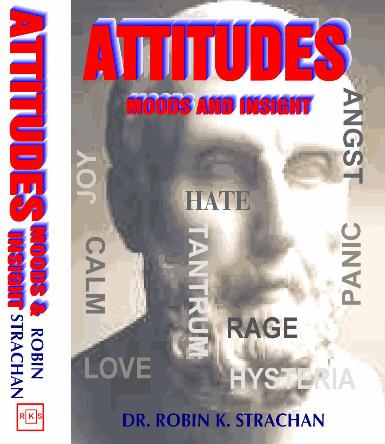
book in the trilogy. It moves the discussion about use of
the 'Moodgrid' on to include the Third Dimension, namely
'Insight' and the Fourth Dimension, namely 'Time'. It must
be clear even to a novice observer of human nature that
people can either be very straightforward about how they
express themselves, or can use complex arguments of
various kinds to promote their ideas and justify their
actions. On the other hand some people can hone their
social skills to the point of being devious. They can then
use their understanding not only to manipulate others, but
also to disguise their true intent.
This ability to voluntarily modify one's behaviour,
particularly in order to influence others is therefore the
essence of this work. The book commences with relevant
chapters of 'Partners from Heaven and Hell' for the
purposes of reference, but moves on in it's second part to
consider the subject of 'Human Insight' with regard to such
matters. It then describes use of the 'Third Dimension' (Z )
in the formulation of a logical extension of the 2-D 'grid
hypothesis' into a 3-D 'cubic hypothesis'.
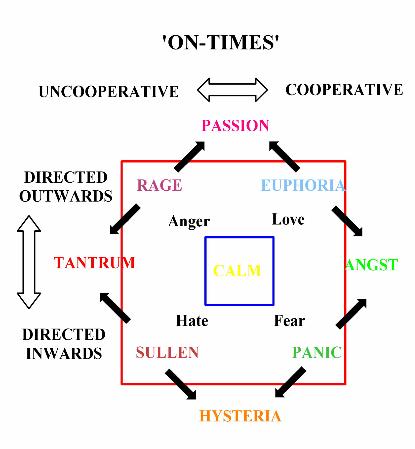
LOW INSIGHT ( score of 0 - 2 on the Z - axis)
The hypothesis goes that very low insight individuals are
by definition 'ignorant'. They fail to recognise or
comprehend their mood state and do not tend to fully
appreciate the implications of having such feelings. They
also therefore will tend to have little control over their
emotions as shown in the adjacent diagram, swinging to
the edges of the grid on a frequent basis. However, with
experience of life, most of us will at least gain some insight
by learning from those experiences. However, for a large
proportion of people, life is a constant struggle against
such mood swings.
We will all therefore at some time or another, have
experienced feelings such as 'rage', 'euphoria', 'panic' or
'sullenness'. We then can recognise those feelings and if
they were pleasant we may wish to repeat them or avoid
them if they were unpleasant. This however is still only a
fairly low insight position to be in, because these emotions
are still probably not being adequately related to each
other. Also their causation may well not be well
understood or properly associated with the amount and
direction of mood change. When these 'base' emotions
come into conflict, then more unusual behaviours may
occur as shown.
Such 'lower insight' individuals can be then classified
according to their 'base positions on the 'grid'. If they
possess extreme attitude sets, they will tend to occupy the
peripheral sub-zones in the lowest part of the
'psychometric cube'. These relatively 'ignorant' sub-zones
include the panicky 'slave', the naive, generous and
'gullible' type, the aggressive but uncomplicated selfish
'villain' and the cynical and destructive 'bully'. Such people
are well recognised as being likely to exhibit fewer
'voluntary' or 'considered' actions.
MODERATE INSIGHT ( score of 3 - 5 on the Z - axis )
There is a danger here as experience and confidence
develops and particularly when we begin to feel
'comfortable' with our feelings, that some people can start
to base their 'personal philosophy' upon a set of extreme
and 'peripheral' attitudes associated with an insane 'base
mood'. A conscious and 'voluntary' intellectual element
begins to be introduced closely associated with the natural
emotional 'habitat' for that individual. This intellectual
activity may therefore result in some quite extreme and
even bizarre thoughts. These thoughts may then be
capable of overruling our 'base moods' at least some of the
time, but may come into conflict with other extreme
emotions arising from another parts of the grid.
According to their 'base position' and the associated main
attitude sets, such people will perhaps become one of
several main groups of people who 'occupy' as it were the
'higher' but still quite 'peripheral' sub-zones within the
psychometric 'cube'. These include the selfish 'tyrant', the
over-generous and heroic 'romantic' , the humble and
servile 'ascetic' and finally the still hateful but clever
'sceptic'. These people are of course easily identified by
their skill at manipulating the minds of others by use of
various strategems which are common to their 'sub-zone'.
These strategems inevitably exploit the gullibility and
weaknesses of their relatively 'ignorant' and subordinate
targets. These strategies are to be mentioned in this book
but are greatly expanded upon in Book 3 (PPS).
When someone becomes a student of Psychology, they
begin to analyse people's feelings more comprehensively,
perhaps even using 'concepts' derived from a version of
existing contemporary Personality or Mood theory.
However, until such a person begins to relate attitude sets
and moods to some form of 'psychometric' analysis, then he
or she is still unlikely to be able to move on to the kind of
understanding which is necessary to comprehensively
relate one mode of thinking to another. In other words,
even such an 'educated' person will not be in a position to
use mathematical ideas to assist in the analysis of
attitudinal change, mood swings, the qualities of
inter-personal interactions and the proper classification of
personal philosophies. By definition such a person should
still be given a score for insight of no more than five.
HIGH INSIGHT ( score 6 - 8 on the Z - axis )
When an individual begins to use Psychometrically based
Mood Theory and in particular uses Three-Dimensional
Attitudinal Analysis as shown, they then can by definition,
begin to qualify for 'insight' scores of 'z' higher than five.
There is still the danger however that their ideas will
remain 'skewed' as it were by their 'base' personalities and
that they will try to use their psychological skills to promote
relatively peripherally based (insane) ideas. Indeed it
would appear more likely than not, that in the future, higher
insight Philosophical positions on the grid such as
'Tyrannical', 'Sceptical', 'Idealistic' and 'Relativistic' (see
PPS) will continue to be used to manipulate others for
personal and 'social group' gain. Only when a person's
philosophy is truly based upon a 'centred' set of ideas will
prejudices and insane actions be minimised.
In this book therefore the advantages and disadvantages
of 'occupying' each sub-zone is discussed. Jargon is used
frequently, but is usually defined and explained. Shapes
and forms are used to describe individuals and
philosophies alike. More complex dimensions such as
'Politically Correct - Non Correct' (Idealistic-Sceptical) can
be orientated along specific axes alongside many others.
Also, various elementary pieces of biological and
neuro-physiological information are presented as being
highly relevant to the understanding of such matters.
POINT 'P'
No-one can be all-knowing and the limit for 'sane' human
comprehension would appear to be best defined as being
within reason and certainly within reality. In other words it
seems very possible that an individual might delude
themselves to think that they knew more than it is possible
to know. As a result of such a possible mental state, one
by definition cannot have a view within reason greater than
a score of 8 on the z-axis. A score of higher than nine is
used to denote someone who has lost touch with reality.
The Philosopher's Point 'P' therefore has coordinates of
5,5,8. as shown and denotes a perfectly sane and balanced
view based upon psychometric knowledge, but with insight
still remaining within reason. Where more peripheral belief
systems operate outwith the bounds of reason or reality,
then phenomena such as repression and denial seem to
occur.
THE FOURTH DIMENSION - 'TIME'
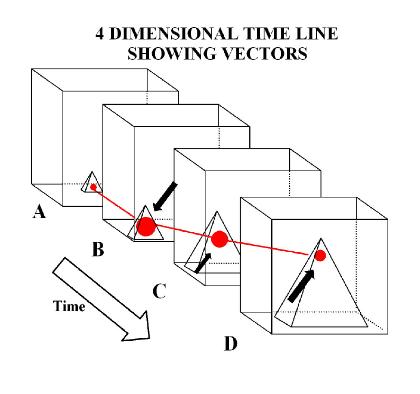
The fourth dimension 'time' is also considered in some
detail in terms of the 'Shifts', 'Drifts' and 'Journeys' that can
be made at different rates across the psychometric
'grid-space'. 'Shifts' imply being pushed as it were across
the grid-space by acute, transient and strong emotional
forces. 'Drifts' imply slower processes of change perhaps
caused by gradual assimilation of knowledge, educational
processes or even indoctrination. 'Journeys' implies that
one had a map of some kind and headed as it were towards
a certain attitudinal 'goal'. However, as we all know,
people were travelling the world even when they thought it
was flat and when they had no comprehension of true
distance and bearings! Applied psychometrics in this
context offers as it were a 'map' to follow.
PERSONALITY TYPES
Different types of individual therefore can be 'visualised'
by the 'spaces' which they occupy within the 'cube'. This is
firstly in terms of their base attitudes and secondly by their
levels of sophistication with regard to how they use their
various interpersonal, social and even political stratagems
to manipulate and control others. The more extreme their
views, the more eccentric and insane their arguments will
become. From over-generous and idealistic degrees of
political correctness (heroic sub-zones) to extremely bitter
and twisted, destructive nastiness (sceptical sub-zones),
all such individuals have their place within the 'cube'.
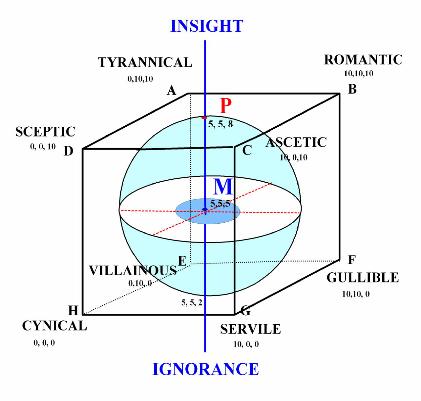
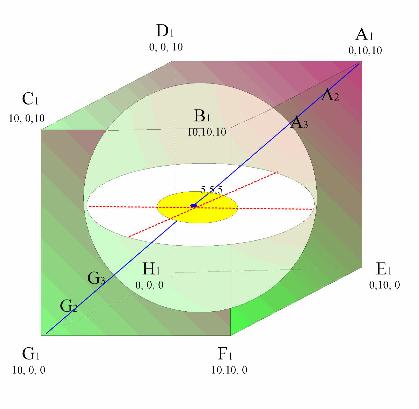
A series of 'insight dimensions' can therefore be seen to
be passing obliquely in different directions through the
'cubic psychometric space'. For example, a line passing
from point 'A' to point 'G' joins the diametrically opposite
high insight 'heroic' and 'generous' corner with the low
insight 'cynical' and 'mean' corner. Various other attitudes
and attributes can be identified as approximately following
this dimension. For example, high levels of 'Political
correctness' are found at point 'A', where extreme idealism
and generosity towards others makes people wish to
consciously give up their own rights often to the point of
significant self-harm. 'Political incorrectness' on the other
hand is best seen at point 'G' where the sensitivities and
rights of others are cynically ignored. Both are by
definition a form of insanity in terms of the exhibition of
behaviour either 'beyond reason or reality' where harm to
oneself or others takes place. All of these main axes are
described and discussed in this book, but with more detail
and the precise application of the theory being left to
Book 3.
PHILOSOPHICAL POSITIONS
This book therefore attempts to introduce the concept
that such a lowest common denominator psychometric
method can be used to assist one's understanding of
several academic disciplines. A brief description of how
this method relates to the understanding of social,
political and religious matters is made in this book, but
with once again the detail being left to Book 3 (PPS). Also
in Book 3 the various causes for such variation in
attitudes is discussed in relation particularly to brain type
and function.
It is the author's opinion therefore that such a
neuro-physiological and psychometric polymathic
approach to social studies in general can be invaluable.
Analysis of the various types of 'Insight' seems to provide
a method for comparing and contrasting some of the
diametrically opposed views that exist. The system also
seems to offer a method of analysing 'bipolar'
philosophies, where for example, such insane people can
justify or 'balance' the 'evil' and selfish acts that they do by
having equally deluded idealistic beliefs. Such analysis of
'Insight' may indeed be the key to obtaining high degrees
of precision when it comes to understanding all the
various possible 'philosophical positions' adopted by
various categories of politically insane individuals. A
description of these various 'positions' therefore forms
the structure for Book 3 entitled 'Psychometrics,
Philosophy and Society'.