developing insight about all aspects of human activity. Extreme attitudes are seen to
equate with insanity, but also seem extremely important when trying to understand
personality, relationships, philosophy and social interactions".
 | |  | |  | |  | |  |

proposed by Dr Robin K Strachan. It has been devised as a
'user-friendly' version of 'temperament theory' and is based upon
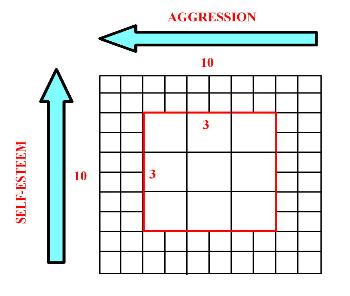
the concept that levels of 'aggression' and 'self-esteem' are the
'prime' attitudes of 'social man'. When arranged as shown in the
adjacent diagram, they seem to correlate with and may even
determine most other 'secondary' human attitudes and their
associated Moods.
'SANITY DEFINED'. 'Sanity' is defined by the Oxford Dictionary as
the 'avoidance of extreme views'. The 'moodgrid' therefore seeks
to define 'sanity' by analysing human 'attitudes', 'moods' and even
the amount of 'insight' we have in terms of a 'grid'. These attitudes
are 'scaled' across the grid as a series of 'dimensions', with high
and low values for each dimension occurring at the 'edges'. The
'centre' squares of the grid can therefore be considered to
represent a series of means or average values, which can then be
defined as a zone of 'calmness', 'sanity' and 'reason'.
The grid itself can then be divided into a series of 'Zones' which
not only relate to different moods as will be discussed, but also to
more complex aspects of behaviour. An amazing number of
correlations with different aspects of life can be seen using this
method. These ideas are described in some detail in the three
books presented on this site, including many aspects of
psychology and even philosophy.
WHY AGGRESSION AND SELF-ESTEEM?
The tendency to exhibit higher or lower levels of aggression
(x-axis) seems to be at least partly driven by one's sex and brain
structure, that is to say one's genotype. However, one's level of
self-esteem (y-axis) seems to be in large part driven by social
events and particularly one's perception of how one fits into the
hierarchies which continually form within most social groupings.
However, both levels of aggression and self-esteem can be
subject to large fluctuations caused by social events. Secondary
physiological changes can follow such events including
neuro-chemical and hormonal variations which in turn can have
their own 'knock-on' effects.
MOODS AND ZONES
Attempts can therefore be made to 'measure' the resulting relative
strengths of the individual attitudes for each section of the grid.
For convenience, a decimal system has been employed
throughout the construction of the hypothesis, with a central
section of nine main areas or 'sub-zones representing the most
commonly held 'Moods of Man'.
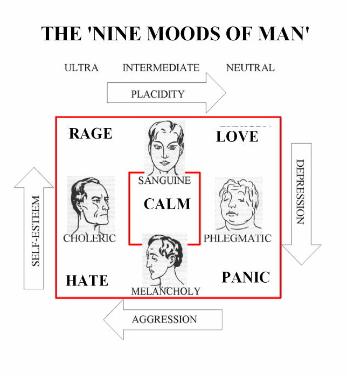
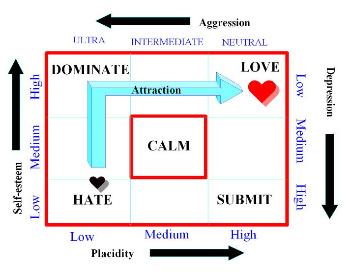
The traditional 'Four Moods of Man' (Allport's illustrations), namely
'Choleric' (Angry), 'Sanguine' (Optimistic), 'Phlegmatic' (Accepting)
and 'Melancholy' (Sad) are seen to fit in to the modified grid as
shown. The corners of the grid can then be best named as areas
of Rage, Love, Panic and Hate. The most emotionally
well-balanced and final, ninth area of the grid is the central area of
'Calm'. Fortunately, for most of our lives and during most
interactions, we are able to live our lives 'centred' as it were in
such a state of emotional balance.
LEVELS OF SELF-ESTEEM
The grid has been firstly subdivided horizontally into areas of
High, Medium and Low levels of Self-esteem. These boxes can be
seen on several of the diagrams shown. As is discussed
throughout the series of books, one's levels of self-esteem has
significant implications for many aspects of personality.
LEVELS OF AGGRESSION
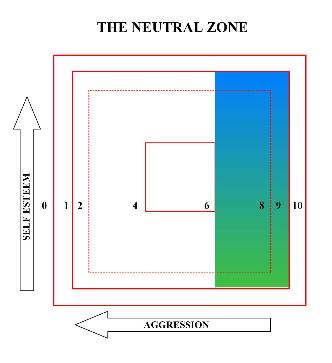
The grid has also however been divided vertically into three major
zones. Where levels of Aggression are high on the left hand side
of the grid, the area has been called the 'Ultra Zone'. The term
'ultra' in this context implying extreme and excessive degrees of
such aggressive behaviour. In recognition of those ancient
philosophers who valued balance or 'intermedios' in their
thoughts, the central third of the grid has been called the
'Intermediate Zone'. Low levels of Aggression are found on the
right of the grid in the so-called 'Neutral Zone', which has been
named in relation to the passivity engendered by such an
emotional state. It's location and dimensions are as shown, with
the blue sub-zone representing high self-esteem and the green
sub-zone low self-esteem.
PERSONALITY
Individuals seem to lead their lives with a tendency to mainly
'inhabit' one 'sub-zone' or another. As such, these tendencies
form the basis of a 'personality'. The grid can also therefore be
readily used to classify personality into 'centred' or 'peripheral'
types.
Different combinations of attitudes, displayed with well defined
and specific intensities, can then be recognised as the 'mood'
associated with that area or sub-zone of the grid. 'High' and 'low'
values for most attitudes therefore will be tend to be found at the
edges of the grid. Therefore relatively 'insane' attitudes 'beyond
reason' and in more severe cases even 'beyond reality', will tend
to be found when individuals have personality types close to the
edges of the grid or where mood swings take them there on a
frequent basis.
CHANGES AND FORCES
The grid system can therefore be used on an almost instantaneous
basis to assess an individual's short term and temporary changes
in attitudes and mood. The system can also be used to consider
longer term changes in attitudes and personality which may have
far reaching effects with regard to many social issues.
Various emotional forces, such as 'attraction', which can
significantly alter mood, can be considered to as it were create
emotional 'vectors' across the grid as shown. Day to day
observation of individuals and even groups of people while using
the grid, tends to reinforce the usefulness of such assessment,
particularly when one begins to consciously consider one's
interactions with others rather than simply using sub-conscious
intuition.
ATTITUDE ANALYSIS
Emotional forces have already been mentioned in terms of being
responsible for emotional 'Shifts' across the grid. However, all
'Attitudes' and 'Attributes' can be classified and grouped together
in terms of how they change according to the specific direction on
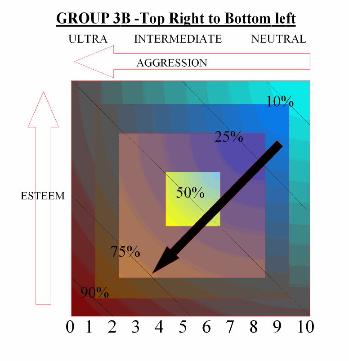
the grid in which maximum and minimum values occur. Once
again a decimal system can be used to consider such matters. The
example shown is of so-called 'Group 3B' attitudes, where the
tendency to exhibit hatred, meanness of spirit, scepticism,
destructiveness and cynicism increases as one moves into the
so-called 'bottom left' of the grid.
ATTITUDES AND 'BRAIN MODULES'
The tendency to possess attitudes of varying strengths seems to
be determined by many factors, but they do seem to vary with our
Mood in predictable ways. Our tendency to possess an attitude to
a particular degree will obviously be related to one's past
experience and the present environment. However, the structure
of our brain in terms of the size of particular 'functional modules'
and how active they are at any one time, will also at least partially
determine our feelings and reactions to events.
The size of many of these 'modules' is determined firstly by one's
genes and then also by hormones during pregnancy. The
'sex-specific nuclei' which determine our levels of aggression and
sexuality are particularly sensitive to hormones such as
testosterone at this time of our development. As such, our
personality will be shaped for the rest of our lives.
However, problems do seem to arise particularly when any one
such module takes over our mood. Even more trouble seems to
arise when more than one module comes into conflict with another.
Attitude: - 'a mode of thinking' (subjective).
Attribute: - 'belonging to, or appropriate to
an individual' (objective).
Mood: - 'a state of (certain) feelings'.
Sanity: - 'the tendency to avoid extreme views.
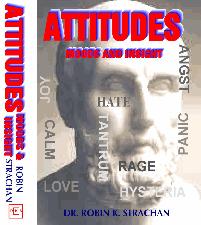
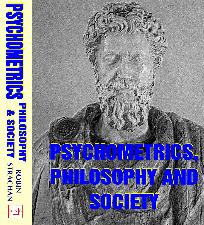
A series of three books dealing with all such matters is under construction, two of which are available today as
First Editions. The illustrations shown are just a small sample of the several hundred which have been used to
convey the various ideas. All three books use the 'Moodgrid' to consider various aspects of Human Behaviour
and Social Interaction. They all employ the same above mentioned 'lowest common denominator' approach to
understanding human nature. They are each described in some detail on the other pages of this website. Please
Click on the links at the top of the page for more information. Some Historical background is also included at the
end of the 'PHH page'.
BOOK 1. 'PARTNERS FROM HEAVEN AND HELL' (PHH) - Available December 2006
BOOK 2, 'ATTITUDES, MOODS AND INSIGHT' (AMI) - Available 2007 - Advance Orders Accepted
BOOK 3. 'PSYCHOMETRICS, PHILOSOPHY AND SOCIETY' (PPS) - In Preparation